
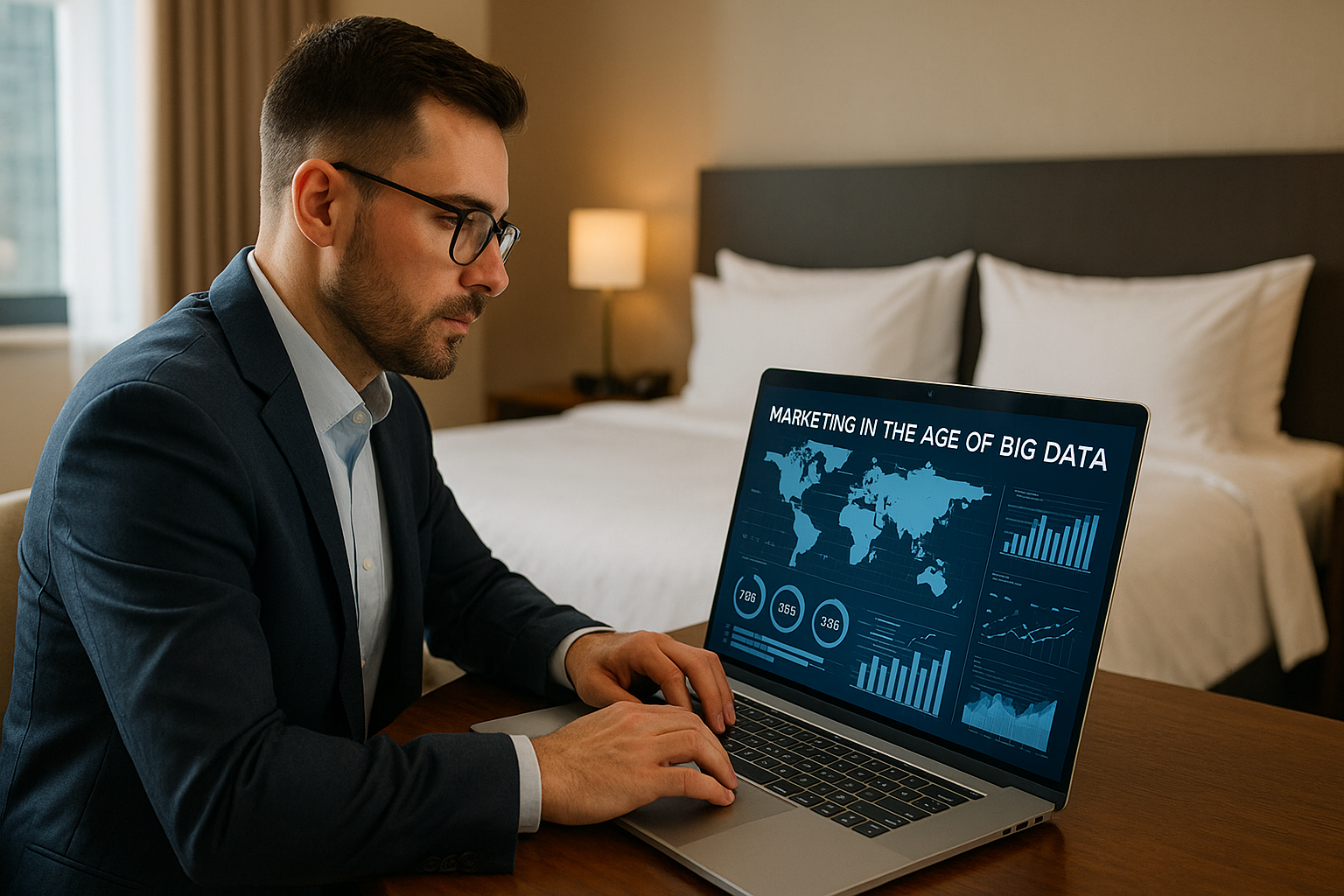
The hospitality industry has always been about experiences, relationships, and human connection. Yet, in 2025, those connections are increasingly being shaped by data. Guests leave digital footprints at every stage of their journey—when they search for a property, compare rates on OTAs, log in to Wi-Fi, book a spa treatment, or leave a review.
The difference between hotels that thrive and those that lag is not the volume of data they collect, but how effectively they convert raw information into timely, personalized actions. In an age where global giants like Accor, Marriott, IHG, and Hilton are building enterprise-wide Customer Data Platforms (CDPs) and loyalty-driven personalization engines, independent and regional hotels must ask: how can we translate big data into meaningful marketing impact without overwhelming budgets or staff?
1. What “Big Data” Really Means in Hospitality
In many industries, “Big Data” conjures images of vast warehouses, AI pipelines, and predictive analytics. For hotels, it is more practical and targeted: a unified, consented guest profile that allows recognition and personalization across the stay lifecycle.
Key data domains for hotels:
-
Core guest identity & stay history: PMS/CRS data—bookings, room type, ADR, channel, frequency.
-
Digital behavior: website clickstream, mobile app events, abandoned searches, quote requests, call center metadata.
-
On-property spend: POS (restaurants, bars, spa, banquets), Wi-Fi usage, activity sign-ups, transportation.
-
Feedback & sentiment: NPS surveys, TripAdvisor/OTA reviews, social mentions.
-
Marketing engagement: email/SMS/WhatsApp open/click rates, ad interactions, match rates.
In short: it’s not about volume, it’s about connecting silos into one living record per guest.
2. The Guest Data Architecture of 2025
Hotels at every scale are converging toward a similar architecture:
-
Data collection & pipelines: PMS, booking engine, POS, Wi-Fi, and web/app analytics flow into a warehouse or CDP.
-
Identity resolution: deterministic matching (email, loyalty ID, phone) builds “golden profiles.” Probabilistic matching (device, booking behavior) adds flexibility but must respect privacy laws.
-
Consent governance: every consent log stores purpose (marketing, analytics), channel (email/SMS/WhatsApp), timestamp, and jurisdiction. This enables both compliance (e.g., India’s DPDP Act, GDPR) and trust.
-
Activation engines: campaigns fire across owned (email, SMS, app push), paid (Google/Meta custom audiences), and operational (front-desk or call center prompts).
-
Measurement & feedback loop: dashboards focus on revenue attribution, incremental lift, LTV by segment, and media suppression savings.
Case in point: Accor went live with a composable CDP on Snowflake, activated via reverse-ETL into marketing channels, in just two months. The goal: maximize campaign performance, reduce media waste, and personalize at scale.
3. High-Impact Big Data Use Cases in Hotels
a) Abandonment Recovery
Guests who search but don’t book are among the highest-value prospects. Trigger emails or WhatsApp within 2 hours of abandonment with personalized nudges—price alerts, flexible offers, or loyalty-point reminders.
b) Pre-Arrival Cross-Sell
Between booking and check-in lies an upsell goldmine. Use pre-arrival emails to offer upgrades, transfers, dining packages, or spa slots. Suppress offers for elites who already have perks to avoid frustration.
c) On-Property Nudges
Wi-Fi logins or app push notifications can drive real-time upsells: “Happy hour at the bar,” “Dinner table available at 8 PM,” or “Upgrade to late checkout with breakfast.”
d) Post-Stay Winback
Split journeys based on satisfaction:
-
Promoters (4–5★ reviews) → loyalty sign-up, referral request.
-
Detractors (<4★) → service recovery first, then a review request.
e) Paid Media with First-Party Data
Export curated audiences (recent searchers, lapsed elites, high-value families) into Google/Meta. Suppress “in-house” and “just-booked” guests—this alone can save 10–20% of wasted ad spend.
f) Loyalty Personalization
Chains like IHG and Hilton are proving loyalty is more than points—it’s about tailored offers based on spend and interests. Mid-sized hotels can replicate this by segmenting guests into lifestyle-based cohorts.
4. Privacy, Consent, and Regulation: The New Battlefield
India’s Digital Personal Data Protection (DPDP) Act
Enacted in 2023, with draft implementing rules released in Jan 2025, the DPDP law puts consent at the center. Hotels must:
-
Use private, secure methods of data capture (QR forms instead of verbal phone collection).
-
Clearly disclose purpose (“for marketing communications about offers and upgrades”).
-
Maintain auditable consent logs and respect withdrawal requests.
This is not optional—hospitality is a high-risk industry because it processes IDs, biometrics, and payment data.
Global Context
-
GDPR (EU) and CCPA (US) still apply to international guest data.
-
Third-party cookies: Google has shifted to Privacy Sandbox with no hard deprecation dates, but guidance is clear—build for a first-party identity future regardless. Hotels that wait will lose targeting precision as platforms evolve.
5. Wi-Fi as a Guest Data Goldmine
Wi-Fi is more than an amenity—it is a strategic data capture point. With the right captive portal:
-
Guests log in with loyalty ID, email, or phone.
-
Explicit consent is collected for marketing.
-
Profiles sync to the CDP, linking stay identity with digital behavior.
-
The login can trigger automated “Welcome” messages or offers.
But beware of poor execution: insecure networks, overly intrusive pop-ups, or unclear consent can backfire. The best practice is transparent, simple login with clear value exchange (faster speed, member perks).
6. Measuring the ROI of Big Data Marketing
Owners and asset managers care less about dashboards and more about bottom-line impact. KPIs that resonate:
-
Direct revenue mix: YoY growth in direct bookings vs OTAs.
-
Revenue per 1,000 contacts: a tangible way to show list value.
-
Suppression savings: quantifying ad spend saved by excluding in-house/just-booked guests.
-
Journey revenue uplift: A/B test holdouts for pre-arrival upsells or abandoner campaigns.
-
Loyalty LTV: increase in frequency and spend per member.
Revinate’s 2025 benchmark report confirms that hotels using unified data-driven campaigns saw outsized growth in direct channel revenue, while nearly half of hoteliers still struggle to access their own data. That gap is your competitive edge.
7. Pitfalls to Avoid
-
“CDP as a silver bullet.” Tools won’t fix broken strategy. Start with 3–4 concrete use cases.
-
Weak consent lineage. Without purpose-logged consent, audience activation risks legal exposure.
-
Siloed teams. Marketing, IT, and operations must share KPIs; otherwise, the CDP becomes shelfware.
-
Over-reliance on cookies. Even if Chrome delays deprecation, betting on third-party data is a losing strategy.
8. A 90-Day Playbook for Any Hotel
Weeks 1–2: Audit data flows and consent practices. Replace risky practices (verbal phone collection).
Weeks 3–6: Connect PMS + booking engine + email tool into a CDP/warehouse. Resolve guest identities.
Weeks 7–10: Launch 3 high-ROI journeys (abandoners, pre-arrival upsell, post-stay winback).
Weeks 11–12: Activate first-party paid audiences and suppression lists. Run first incrementality tests.
Turning Big Data into Small Wins
Big Data in hospitality is not about size; it’s about relevance, timing, and trust. The hotels that will win in 2025 are those that can:
-
Recognize a guest seamlessly across channels,
-
Respect their privacy and consent,
-
Deliver personalized value at the right moment, and
-
Prove incremental revenue lift to ownership.
The era of guesswork in hotel marketing is over. With the right architecture and discipline, Big Data is not just a buzzword—it is the pathway to stronger direct revenue, deeper loyalty, and more memorable guest experiences.